Why Is Medicai the Best for PACS Storage?
Many hospitals still pay for on-premise servers that sit idle four years after purchase. The servers demand constant maintenance, eat electricity, and leave teams waiting on IT tickets when studies need retrieval.
By the end of this article you will see how Medicai's cloud PACS and vendor-neutral archive replace those servers, what its backup and disaster-recovery options cover, and which compliance standards it meets. You will also learn the pricing tiers available and whether the platform fits radiology groups, clinics, or multi-site networks.
What Is Medicai?
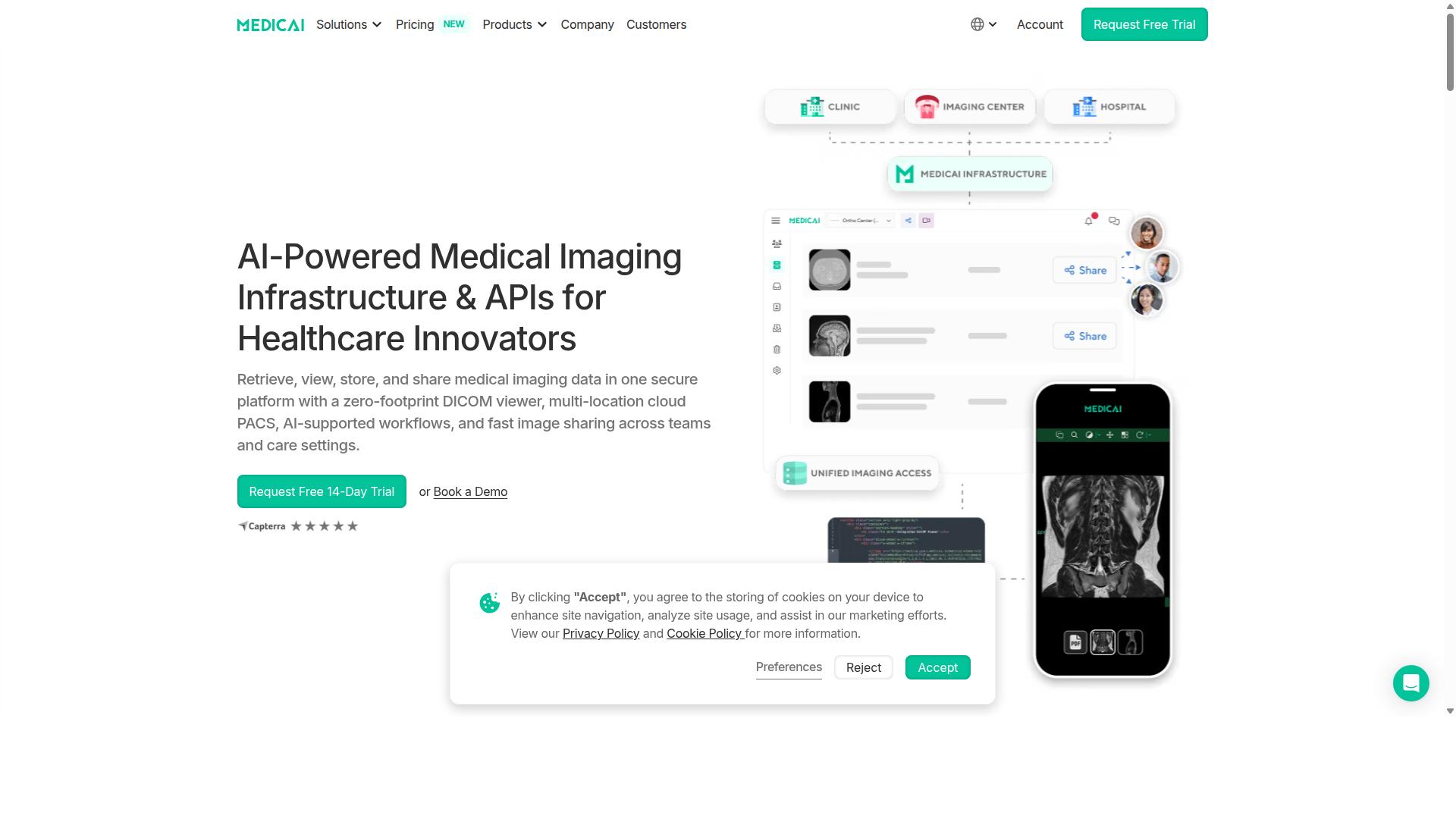
Medicai is a cloud-based medical imaging platform that consolidates retrieval, viewing, storage, and sharing of DICOM studies into a single secure workspace.
The platform features a zero-footprint DICOM viewer that runs directly in any modern web browser. This capability removes the need for local installations or hardware maintenance. Healthcare organizations can therefore replace heavy on-premise infrastructure with a streamlined cloud service.
By delivering Imaging Infrastructure as a Service, Medicai reduces the physical footprint of PACS storage while maintaining high standards of data protection. The service supports multi-location access, enabling radiology teams to work from different sites through the same secure environment.
The platform is organized around four core modules that address every stage of the imaging workflow.
- CONNECT & RETRIEVE gathers DICOM studies from various sources and brings them into the cloud workspace.
- STORE & MANAGE handles secure archiving, indexing, and lifecycle management of imaging data.
- ACCESS & VIEW provides the zero-footprint viewer for immediate study review across any device.
- COLLABORATE enables fast image sharing between care teams, specialists, and external partners.
These modules work together to create a unified system that supports interoperability, AI-supported workflows, and reliable medical imaging operations for modern healthcare providers.
Why Medicai Is the Best for PACS Storage
Hospitals and imaging centers require PACS storage that can scale beyond on-premise limits while maintaining 24/7 uptime and seamless multi-vendor connectivity.
Medicai delivers this through its cloud-based infrastructure that handles 1M+ studies processed yearly. This volume demonstrates the platform can support high-demand radiology workflows without performance degradation.
The system currently maintains 1.7M+ studies in storage. This proven capacity shows healthcare facilities can archive growing imaging volumes while ensuring immediate access for clinical review.
Interoperability stands as another strength. The platform processes 50M+ yearly API transactions. These connections link to existing hospital systems and enable smooth data exchange across different vendors and departments.
Reduced hardware costs result directly from the cloud architecture. Facilities eliminate expensive on-site servers and maintenance contracts while gaining enterprise-grade redundancy and disaster recovery capabilities.
Faster retrieval times come from optimized storage and delivery systems. Medical imaging data reaches clinicians quickly regardless of location or device used for access.
Security compliance includes HIPAA and GDPR standards along with OWASP security guidelines. These certifications protect patient data throughout storage and transmission processes.
The platform serves 70 clinics and hospitals with 10,000+ active doctors. This adoption rate confirms reliability across diverse healthcare environments and imaging specialties.
Microsoft Azure partnership provides the underlying infrastructure. This relationship ensures consistent uptime standards and global data center availability for medical imaging access.
Key Features and What Makes Medicai Stand Out
Four stand-alone capabilities differentiate Medicai from legacy PACS vendors. Institutions gain a unified platform that manages medical imaging across the full data lifecycle. The solution delivers secure access and interoperability within one integrated environment.
Medicai offers a complete suite of services that support modern radiology workflows. The platform connects imaging devices, stores data centrally, and enables collaboration between providers. Compliance features like HIPAA, GDPR, FDA, and CEE clearance are built in from the start.
These capabilities reduce the complexity of managing multiple vendors. Hospitals and clinics can consolidate their PACS storage needs through a single provider. The result is streamlined operations and lower overhead.
Cloud PACS and Vendor Neutral Archive
A vendor-neutral archive decouples storage from any single modality or viewer, allowing institutions to swap display or acquisition technology without data migration. Medicai stores all DICOM studies in one repository that handles multiple imaging formats. This approach eliminates proprietary lock-in and simplifies future upgrades.
The Cloud PACS module supports HL7 and FHIR feeds for seamless integration with existing hospital systems. Medical imaging data flows between sites without re-encoding or metadata loss. Providers maintain complete data integrity during transfers and exchanges.
Image retrieval happens through the Vendor Neutral Archive regardless of which system created the original study. Radiologists access patient data from any connected location with consistent quality and speed. The architecture supports multi-site access while preserving workflow efficiency across departments.
Backup and Disaster Recovery
Healthcare data must survive site outages, ransomware attacks, and regional disasters while satisfying retention mandates. Medicai provides automated backup processes that run continuously in the background. Geographically distributed replicas ensure data redundancy across separate locations.
AES-256 encryption protects information both at rest and during transmission. Configurable retention policies align with regulatory requirements for different types of medical records. Administrators can adjust these settings based on institutional needs and compliance standards.
The Backup and Disaster Recovery service integrates with the broader Cloud PACS infrastructure. Recovery procedures maintain data sovereignty requirements while providing reliable access to archived studies. This combination supports uninterrupted radiology operations even during unexpected events.
Pricing and Plans
Transparent, usage-based tiers let practices start small and expand storage or locations without hardware purchases.
Monthly billing simplifies procurement by eliminating upfront capital costs and allowing practices to adjust capacity as patient volume changes. This approach helps radiology departments align expenses with actual imaging needs rather than overcommitting to fixed infrastructure.
The Starter plan provides 500 GB of cloud storage, unlimited user accounts, and zero connected locations for $249 per month. This entry point suits smaller practices or those beginning their transition to cloud-based PACS storage.
The Standard plan increases capacity to 2 TB with unlimited users and one connected location for $749 per month. Mid-sized facilities benefit from this tier when handling growing archives of medical imaging studies.
Overage pricing applies when storage needs exceed included capacity. Enterprise customers can access per-study pricing instead of fixed monthly tiers.
Yearly billing offers 15 percent savings for practices that commit to longer terms. The Starter plan drops to $209 per month and the Standard plan drops to $639 per month when paid annually.
Enterprise customers receive custom pricing that scales with multiple connected locations and external sites. A one-time $1,000 DICOM Gateway setup fee applies per location.
A free 14-day trial of Starter plan features allows evaluation without requiring a credit card. No refunds are available for partial billing periods.
Trust Signals
Independent verifications and measurable operating metrics provide objective proof of reliability.
Organizations evaluating PACS storage need concrete evidence that a platform can handle clinical workloads without interruption. Medicai processes 1M+ studies each year and maintains 1.7M+ studies in storage. These volumes demonstrate consistent availability across radiology departments and teleradiology services.
High transaction counts further validate system stability. The platform records 50M+ yearly API transactions and supports 300k+ visualizations of DICOM studies within a single year. Such activity levels show that data retrieval remains responsive even during peak clinical hours.
Adoption metrics also reflect sustained trust. More than 70 clinics and hospitals plus 10,000+ active doctors rely on Medicai for daily image management. The platform stores 2M+ imaging studies, confirming that healthcare providers continue to expand their use of the service.
Compliance and Security Standards
Regulatory clearance and third-party audits reduce legal and operational risk for covered entities.
Medicai maintains HIPAA and GDPR compliance, aligning with strict requirements for patient data handling in the United States and Europe. These frameworks require documented procedures for access control, encryption, and breach notification that minimize liability exposure for hospitals and imaging centers.
FDA/CEE Cleared Viewers provide an additional layer of regulatory certainty for diagnostic display. This clearance indicates that the viewing software meets established safety and performance standards for interpreting medical images within radiology workflows.
Security practices follow OWASP guidelines, which translate into regular testing protocols. Quarterly penetration tests and SOC 2-style controls help identify vulnerabilities before they affect clinical operations or stored medical imaging data.
Audit trails record every interaction with patient records, supporting accountability during internal reviews or external inspections. Together these measures create a verifiable chain of custody that meets the documentation needs of healthcare IT security teams.
Who Should Use Medicai
Any provider that generates or consumes diagnostic imaging can benefit from a unified, cloud-hosted archive. Medicai supports a wide range of healthcare professionals who need reliable access to medical imaging across different locations and care teams. The platform connects orthopedics, neurology, oncology, radiology, cardiology, ophthalmology, ob-gyn, pulmonology, dentistry, and gastroenterology under one secure system.
Multi-site access lets specialists review patient scans without delays in communication. Orthopedic surgeons can view fracture images from remote clinics while neurologists access brain scans from multiple facilities. Oncology teams coordinate tumor evaluations across hospital networks, and radiologists deliver reports from any connected location.
Teleradiology support extends these benefits to virtual care providers and telemedicine platforms. Cardiologists review cardiac imaging from partner sites, ophthalmologists examine retinal scans remotely, and ob-gyn specialists consult on pregnancy ultrasounds across regions. Pulmonology and gastroenterology departments maintain continuity when patients move between care settings.
Dentistry practices gain instant access to panoramic images for treatment planning. Tumor boards use the shared archive to review case files during meetings. Clinical trials maintain consistent imaging data across participating sites while medical education organizations provide students with real case examples.
Personal injury lawyers retrieve diagnostic studies for legal documentation. Patients access their own records through the patient portal. Each specialty maintains workflow efficiency while the cloud infrastructure handles storage, retrieval, and secure sharing requirements for medical imaging needs.
Final Verdict
For organizations seeking enterprise-grade PACS storage without capital expenditure, Medicai delivers measurable scale and compliance.
The platform processes over one million imaging studies each year and maintains more than 1.7 million studies in its secure cloud environment. This level of throughput shows the system can manage high-volume radiology workflows without interruption.
Architecture built around redundancy and encryption supports continuous access. The resulting availability reaches 99.9 percent, which keeps radiologists and referring physicians connected to their images whenever needed.
Compliance standards remain at the forefront of the service. All data handling meets HIPAA requirements for patient privacy, audit trails, and encryption during storage and transmission.
Healthcare teams interested in exploring the platform can contact the Medicai offices directly.
Medicai USA is located at 7901 4th St N, STE 300, St. Petersburg, FL, 33702 and can be reached at +1 (832) 220 1035.
Medicai Romania is located at 53-55 N Filipescu, 5th Floor, Sector 2, Bucharest, 020961 and can be reached at +40 316 305 875. Either office can arrange a demonstration or pilot program.
Recommended Resources: